Currently Empty: $0.00


Child marriages lead to early maternity, suffering: Union minister at 100-day campaign launch
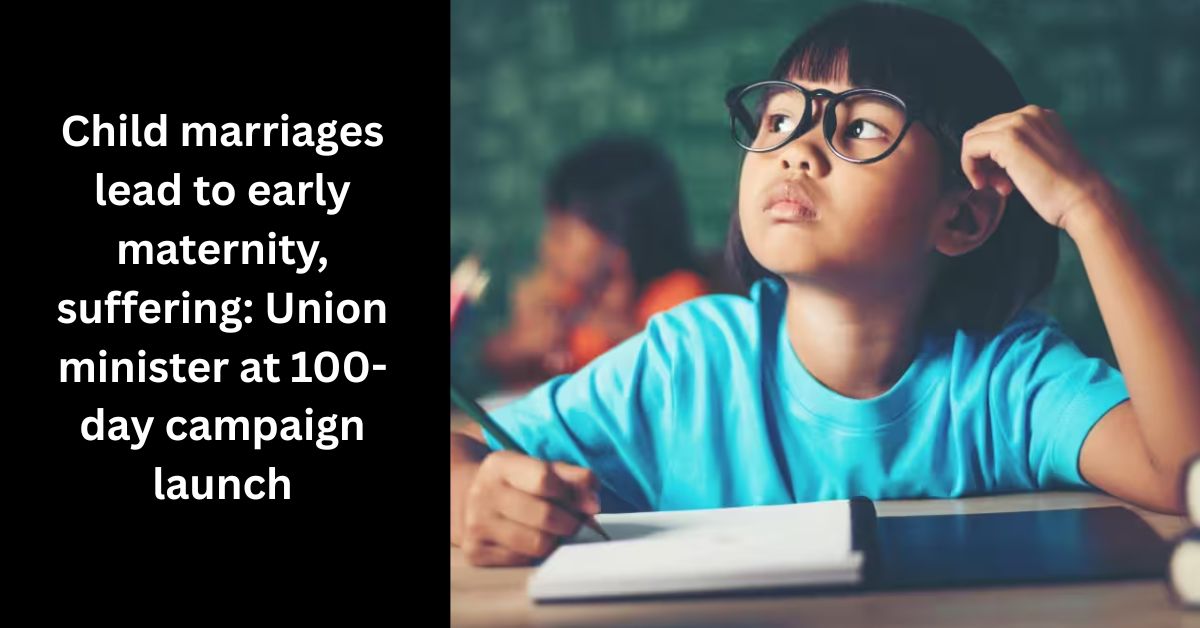
Childhood is meant to be a time of dreams, growth, and learning — not a burden of adult responsibilities before a child has even had a chance to fully grow. Yet, across parts of India, many young girls still face a grim reality: childhood cut short, and thrust into early marriage and early motherhood. On December 4, 2025, Annapurna Devi — the Union Minister for Women and Child Development — struck a chord when she called child marriage a violation not only of law, but of a girl’s childhood, dignity, and future.
According to a recent report by Careers360 (source), many young girls across India continue to face the harsh reality of early marriage and early motherhood, cutting short their childhood. On December 4, 2025, Annapurna Devi — the Union Minister for Women and Child Development — emphasized that child marriage is not only a legal violation but also robs girls of their childhood, dignity, and future. The remarks coincided with the launch of a nationwide 100‑day Intensive Awareness Campaign for a Child‑Marriage‑Free Bharat, signaling the government’s renewed commitment to addressing this social issue.
Contents
Why This Matters: Childhood, Law, and Hope
The history is long. From the early days of the Sarda Act of 1929 to the more recent Prohibition of Child Marriage Act, 2006, India has steadily tightened its legal framework to ban child marriage. Yet despite those laws, harmful social norms continue to force young girls into early marriages — robbing them of childhood, health, education, and the chance to build a life of their own choosing.
As Annapurna Devi said, child marriage isn’t just a legal violation — “it takes away a daughter’s childhood and pushes her towards early maternity and unimaginable suffering.”
But there is hope. According to the Minister, government efforts such as Beti Bachao, Beti Padhao have contributed to rising school enrolment among girls and improving sex ratios — signs that societal attitudes are slowly shifting.
The 100‑Day Campaign: What It Aims To Do
The new campaign — running from November 27, 2025 to March 8, 2026 (which coincides with the next observance of International Women’s Day) — is being rolled out across the country with a multi‑pronged approach that engages schools, communities, religious institutions, local governments, and civil‑society organizations.
Key elements of the campaign include:
-
School and college activities: debates, pledge ceremonies, awareness sessions to ensure children understand their rights and the harms of child marriage.
-
Community engagement: door‑to‑door campaigns, dialogues with families, and involving faith and community leaders to shift long‑standing norms.
-
Legal and reporting mechanisms: More than 38,000 registered Child Marriage Prohibition Officer s (CMPOs) now operate across the country, with a national portal (available in 22 languages) for reporting cases or pledging support against child marriage.
-
Public pledges and social accountability: Last year alone, over 22 lakh people interacted with the portal, and more than 50,000 formally pledged to stand against child marriage.
-
Recognition and community‑level change: Villages and districts that remain child‑marriage‑free may be honored, and local governing bodies are encouraged to declare their areas free of child marriage — building a social and institutional shield around young girls.
The government hopes that with sustained effort, sensitisation, enforcement, and community ownership, India can make child marriage rare if not extinct in the coming years.
What This Means for Girls, Families and Society
At its heart, ending child marriage is not just a legislative or administrative task — it’s about protecting human dignity, enabling dreams, and breaking cycles of poverty and marginalization. By preventing child marriages, girls gain:
-
the right to education — giving them opportunities to build skills, careers, and independent lives;
-
health and safety — avoiding early pregnancies that often endanger both mother and child;
-
freedom and agency — the power to decide if and when to marry, and to pursue their aspirations rather than their community’s expectations;
-
a better future for families and communities — more educated, empowered women contribute to healthier families, stronger communities, and a more progressive society.
It also sends a message: that no law is meaningless, and when society works together — parents, teachers, community leaders, government — meaningful change can happen.

Conclusion: A Nation’s Responsibility — and a Girl’s Right
As the 100‑day campaign begins, the message is clear and uncompromising: “Even one child marriage is unacceptable.”
Ending child marriage isn’t just about enforcing laws — it’s about shifting mindsets, building trust, protecting futures. The success of this campaign hinges not only on CMPOs and authorities, but on each one of us: parents who choose education over tradition, teachers who treat children as more than numbers, community leaders who speak up, neighbours who report suspicious activity, and ordinary citizens who pledge: “This will not be my village, my town, my country’s future.”
If we stand together — for justice, dignity, equality — we can give every child the childhood they deserve, and every girl the right to choose her own path.